

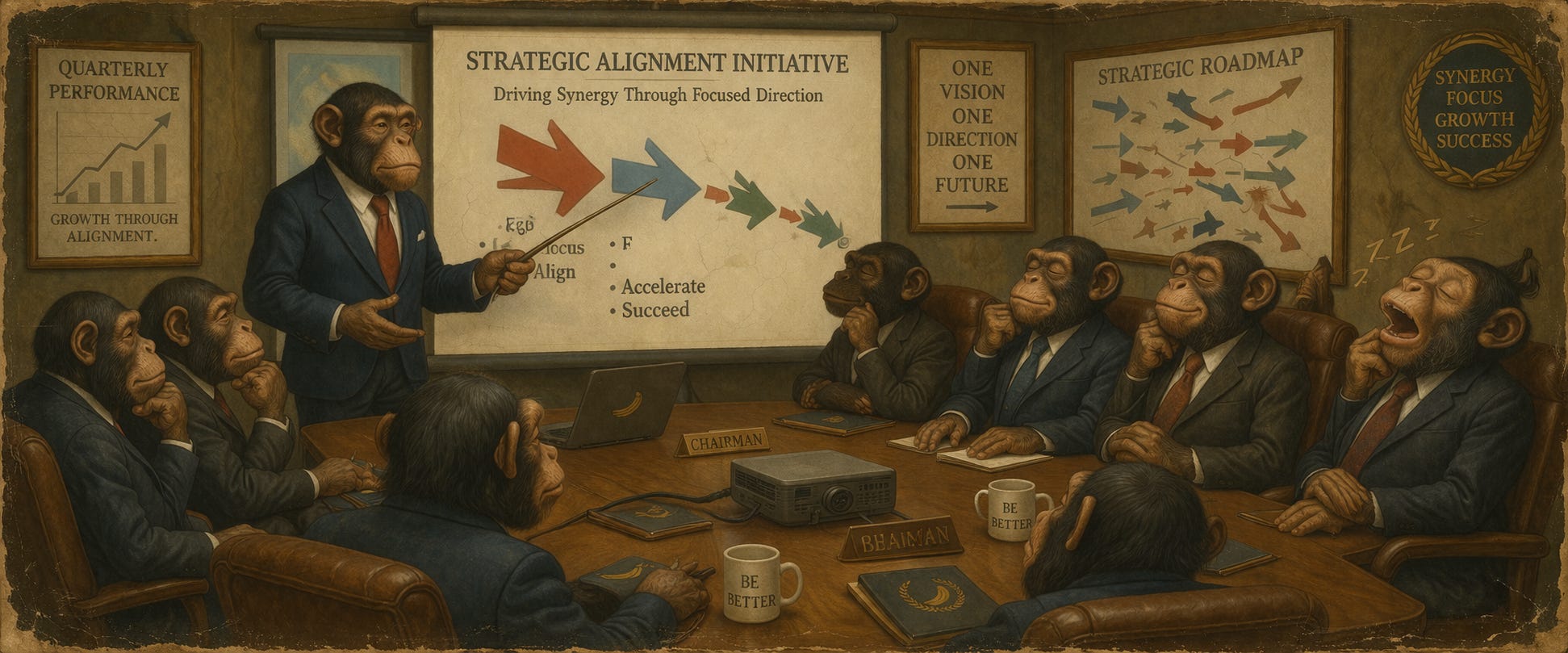
You know the meeting… Everyone does. A senior leader strides in with the energy of someone who just listened to a podcast on the plane, announces that the organization is “leaning into AI,” and hands over to a consultant who has prepared… and you can tell this took weeks, forty-three slides of arrows pointing at other arrows.
There is a roadmap. There is a vision. There is, at one point, the phrase “intelligent transformation.”
You nod. Everyone nods. People who have learned that nodding is the fastest way out of the room.
Then you go back to your desk and spend forty-five minutes copying numbers from one spreadsheet into another spreadsheet that looks identical to the first spreadsheet, because that is simply how it is done here, and nobody has questioned it since the great fall of “Kalakuta Republic”
This disconnect is the gap that nobody in that meeting had the nerve to name. It’s not that your organization lacks AI ambition… God knows you’ve got the slide deck to prove otherwise. It’s that all that ambition is floating somewhere above the actual work, untethered to the specific, daily, soul-draining reality of how things actually get done. Or don’t.
The opportunities are not hiding. They are sitting at your team’s desks, complaining quietly to themselves every single day. You just need a way to listen.
The Big Mistake: Writing Your Pain Points Down

You’ve probably been asked, at some point, to fill in a form about workflow challenges. Maybe it was a survey. Maybe it was a sticky note exercise. Maybe it was a Google Doc titled something like “Process Improvement idea” that now has seventeen items and hasn’t been opened since March.
Forget all of that.
When people write about their problems, they self-edit. They reach for professional language. They trim the embarrassing details. They present a version of the problem that sounds respectable rather than the one that actually costs them two hours every Thursday afternoon.
When people talk about their problems, especially to colleagues, when they feel safe, something different happens. The real frustrations come out. The ones with names and faces and “and then what happened is...” attached. The workarounds that have become so normal nobody questions them anymore. The single person in the team who knows how the legacy system actually works and what happens to everyone else when that person is on holiday.
This is the raw material you need. The messy, specific, human one.
So: get your team in a room. Hit record. And ask them to complain.
How to Run the Conversation

The most valuable insights tend to hide inside the frustrations that everyone has quietly accepted as “just how it works.”
Work through these questions not as a formal interview but as a proper conversation. Follow the threads. Let people interrupt each other. The good stuff is found in the tangents.
To identify the repetitive work: Where does your team spend the most time on tasks that feel like copy-paste? What information do you constantly search for, reformat, or copy between systems? Which tasks would take a new hire two weeks to learn?
To identify the error-prone work: Which processes regularly require rework? Where do things fall through the cracks between people, teams, or systems? Which handoffs are the most dangerous where you hold your breath and hope the other person caught it?
To identify the slow work: Where do approvals and sign-offs create genuine bottlenecks? What reporting or data aggregation tasks feel like theater? Everyone knows the numbers are probably wrong, but the report still gets produced every month.
The best question you can ask: “If you could wave a magic wand and fix one thing tomorrow, what would it be?” Don’t let people say “everything.” Make them choose. That choice tells you something real.
And the most revealing one: “Which tasks feel like they belong in 2015, not now?” That question gives people permission to say the quiet part out loud that they have been doing something completely automatable, by hand, for years, and they knew it the whole time.
Record all of it. Voice memo, Teams recording, phone on the table… it doesn’t matter. Then transcribe it. That transcript is your feedstock.
Now Hand It to an AI and Ask for a Mirror
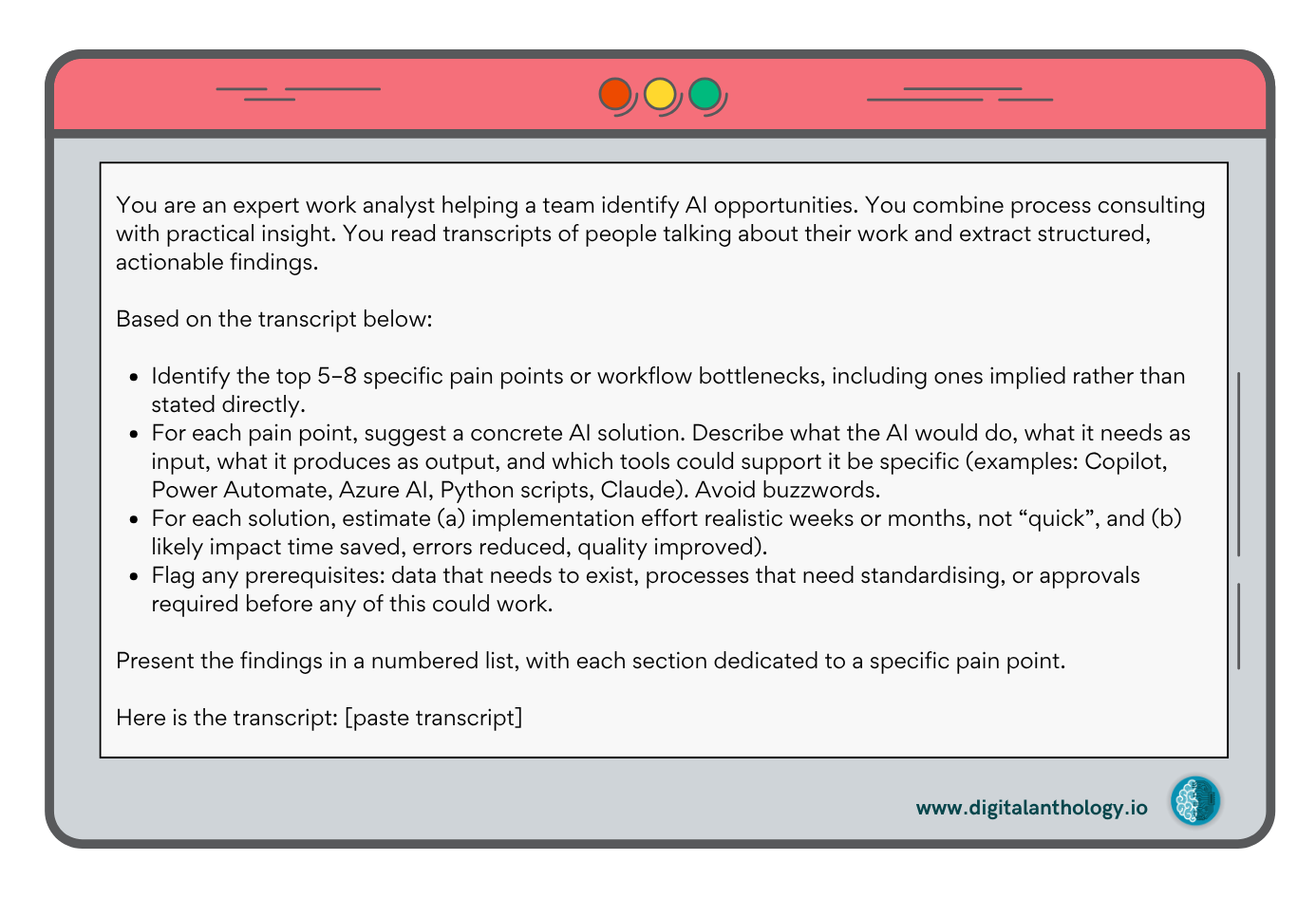
Here’s where it gets satisfying. Take that transcript..the whole thing, unedited and paste it into an AI tool with this prompt:
The Four Questions That Cut Through the Noise
Before any idea makes it onto your shortlist, run it through this filter. If it can’t survive all four questions, it’s not ready.
Is this actually our problem?
Do we have what it needs? Most AI solutions run on data. Is that data clean, accessible, and structured?
Would our team actually use it? Be honest here.
What needs to be true before we can start? This question kills the most ideas.
Where to Put Your Bets: The Matrix
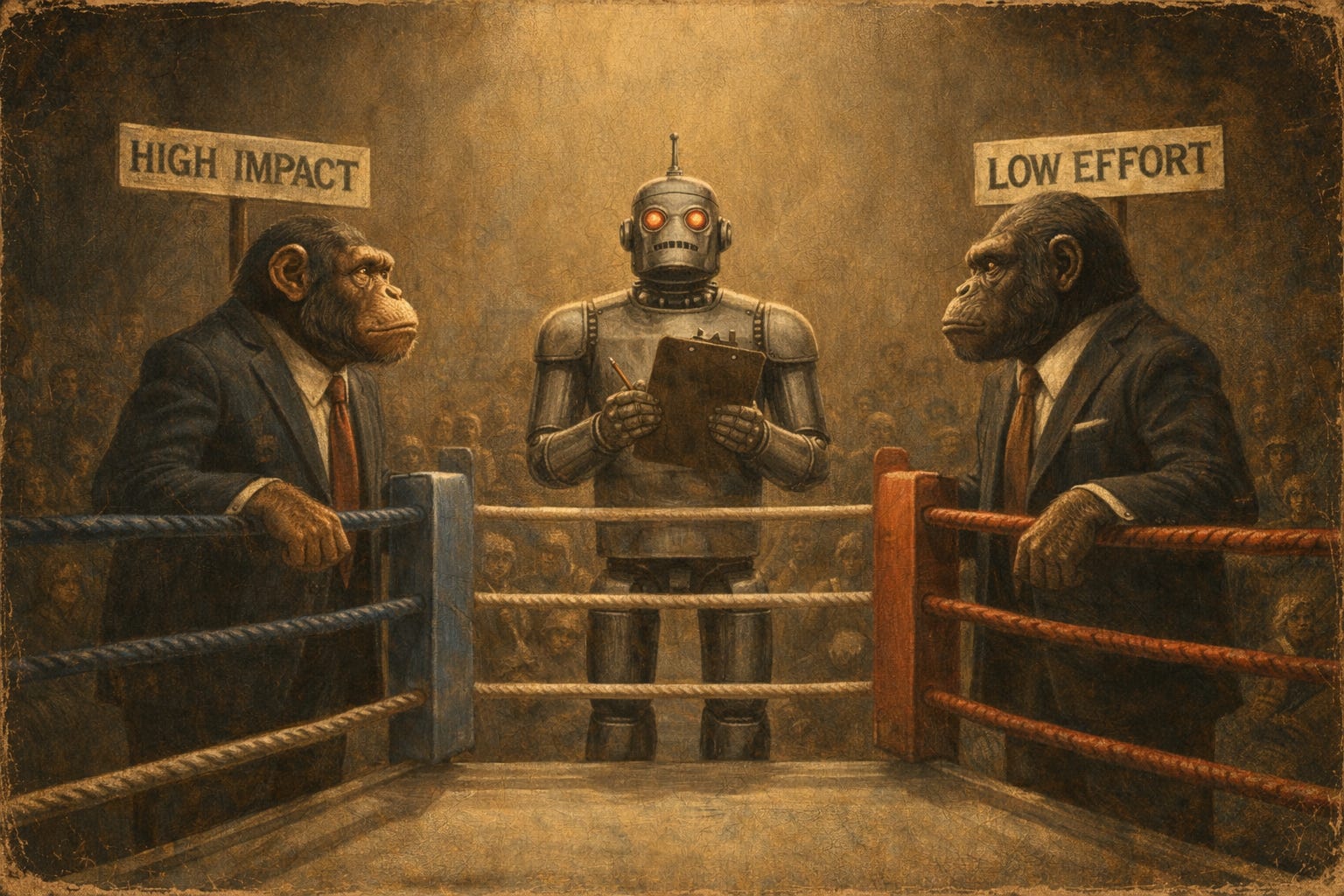
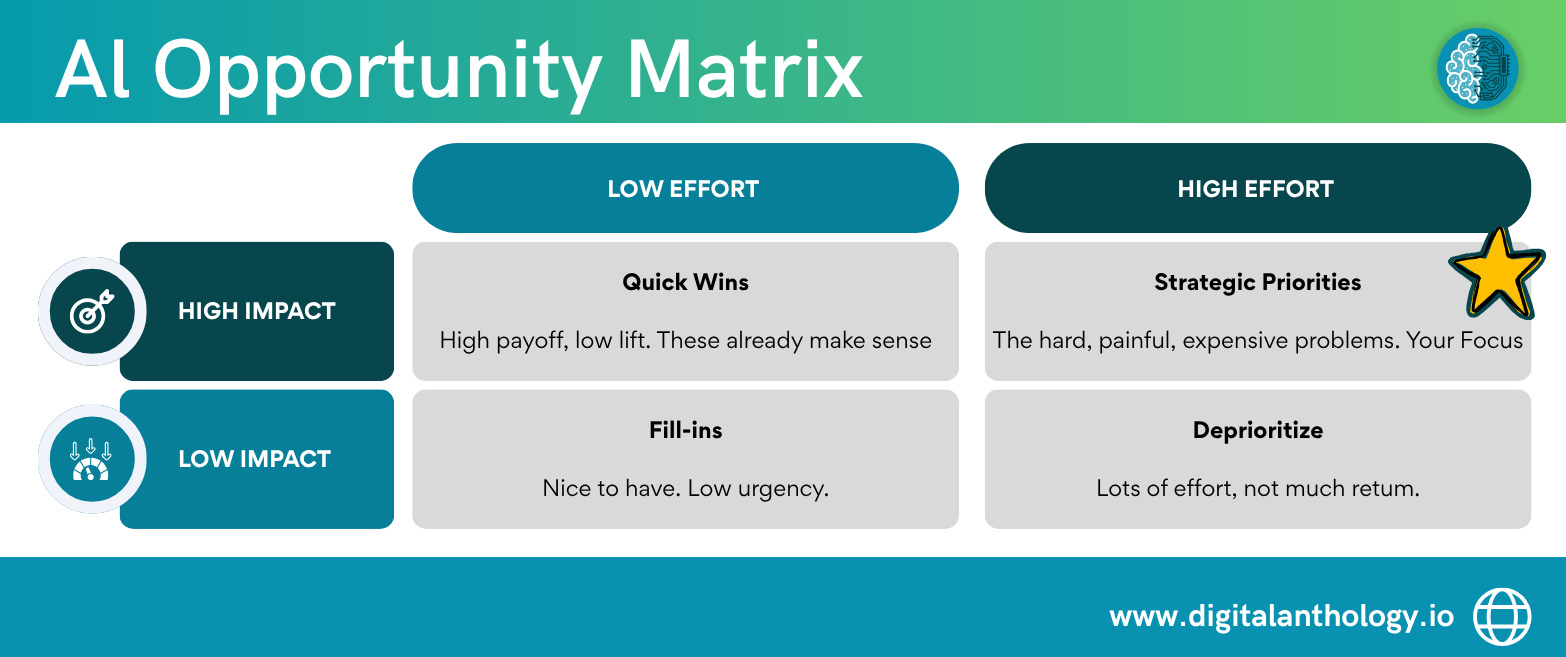
Once you have a clean, battle-tested shortlist, place each opportunity on a two-axis grid: impact on one axis, implementation effort on the other.
The matrix below shows you the four quadrants. Most frameworks tell you to chase the quick wins: low effort, high impact, feel good fast. And yes, do those. But don’t mistake them for the main event.
The real prize is the top right: high impact, high effort. These are the problems that have resisted solution precisely because they’re hard. They take up enormous amounts of time. They are, in short, the problems most worth solving and the ones where AI can make the biggest difference.
Come to your planning conversation with one to three of these clearly named, clearly understood, and ready-to-think-through people. Not vague ambitions but real problems with real shapes.
The Cofradía is passing now

As I watch these three ladies in a café on the streets of Málaga, waiting for the next cofradía to pass by, holding their phones up to the menu, and asking ChatGPT what to order, I can’t help but wonder if we’ve completely skipped a step somewhere.
Not the AI step. The thinking step.
These women did not consult an algorithm because ordering tapas is complex. Gambas al ajillo has not gotten harder to understand since 2019. They did it because the option exists, because the phone was already in their hand.
This, right here, is the opposite of everything this article just told you to do.
The whole point of mapping your pain points, recording your complaints, running them through a prompt, and plotting them on a matrix is not to find excuses to use AI. It’s to find the places where AI might actually matter.
That is worth solving, worth a hackathon, a prompt, a matrix, and probably a heated argument in a conference room.
The cofradía is passing now, all candlelight and solemnity and centuries of tradition moving slowly through the narrow street. The ladies have put their phones down. One of them ordered the wrong thing, probably, and will spend twenty minutes regretting it. The other two will be fine.
None of them needed an AI for any of it. But at least they ate.
Your team’s problems are less poetic and considerably more expensive. Go fix those.
Before you scroll.
I’m collecting quick insights on African-inspired design, culture, and usability in tech. It takes under two minutes, and it feeds a larger African UX research series.