

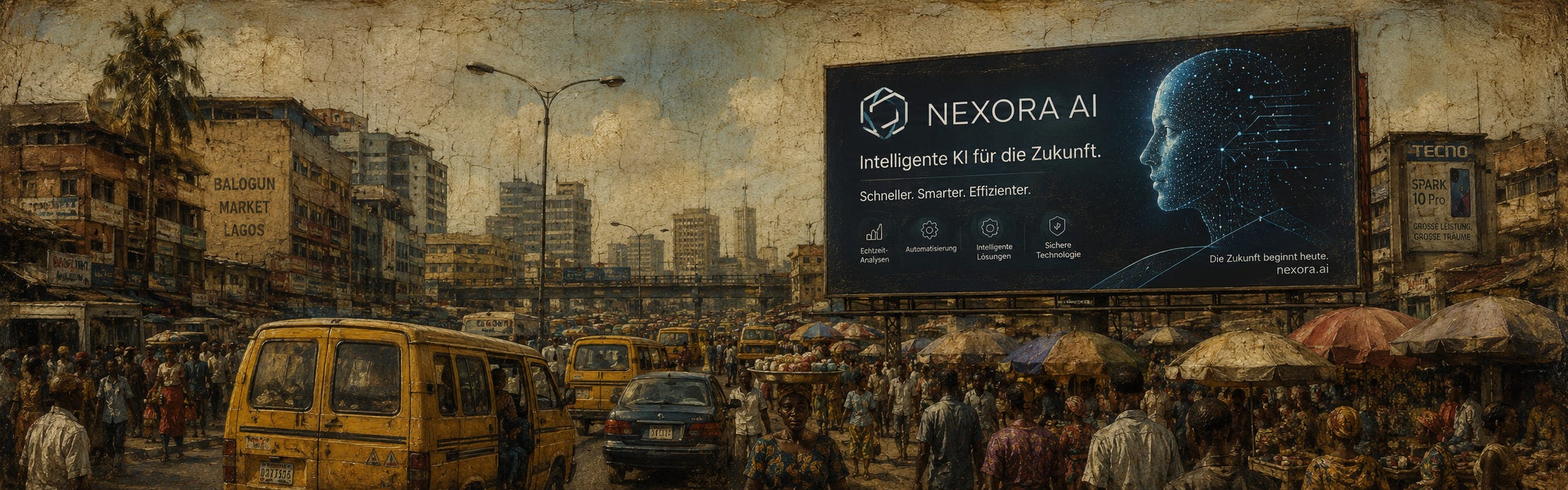
There is a specific type of corporate optimism that was invented for emerging markets. It lives on billboards, in keynote decks, and in press releases that use the word “transform” like punctuation. It currently sounds like this: AI is unlocking Africa’s potential. AI is revolutionizing healthcare across the continent. “AI is here, and it is very excited to meet you."
Africa’s AI market is real, and it is growing at a pace that makes investors speak in hushed, reverent tones. It sits at around $4.5 billion in 2025 and is projected to hit $16.5 billion by 20301. That is a lot of money. That is also a lot of AI tools built somewhere else, for someone else, being parachuted into contexts they were never designed for and declared transformative before anyone has checked whether they work.
This is the story of what gets lost in that translation. It is also, more usefully, a guide to not being the person who buys the mistranslation.
The Farmer Who Asked a Chatbot About Cassava
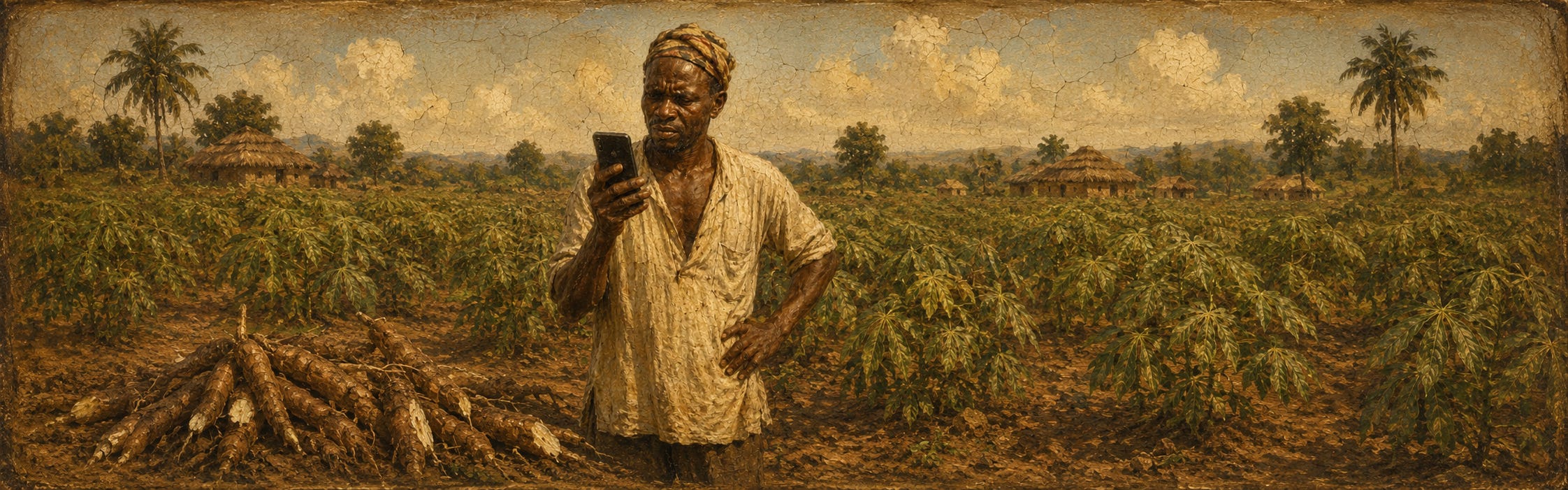
Imagine you are a farmer in rural Abia State. You speak Igbo at home, Pidgin at the market, and English only when you want someone from the city to take you seriously. Your government, an enthusiastic early adopter that it is, has licensed an AI agriculture assistant from a company with a San Francisco address and a mission statement about democratizing access to intelligence.
You open the chatbot. You ask about soil conditions for cassava. The chatbot responds in formal English. Advice was calibrated to temperate climates and growing conditions that have no relationship to your specific patch of laterite earth. It is not wrong in any way it can be sued for. It is simply not for you.
Most available AI datasets are Western-centric, leading to biased outputs when applied in African contexts.2 This is not a controversial finding. It is a documented structural feature of how the industry was assembled. The United States alone accounts for 60% of the world’s top-tier AI researchers and $250 billion in AI investment.3 Africa, in this arrangement, is not a shaper of frontier AI. It is, primarily, a very promising new market for it.
Two Thousand Languages Walk Into a Tokeniser
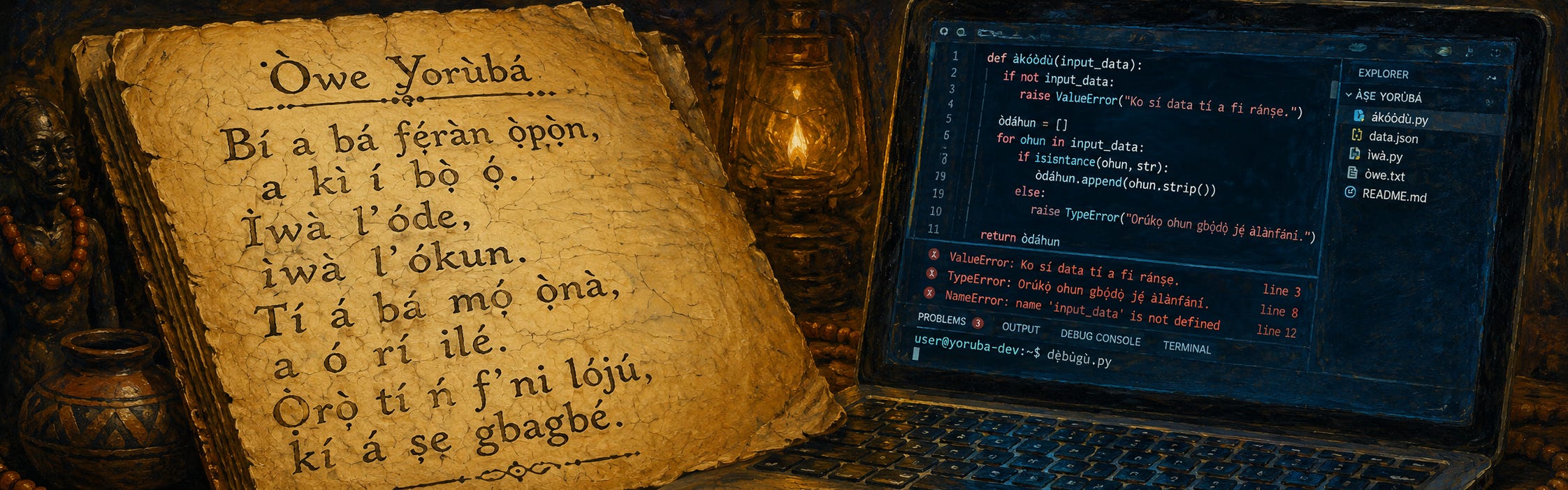
Here is the part where the mismatch stops being merely ironic and starts being technically spectacular. Africa is home to over 2,000 languages4. This fact gets cited so frequently it has lost all meaning, so let us talk about what it actually implies for AI systems built on English assumptions.
Yoruba has a three-tone system where pitch determines meaning; ignore it and you get 41% of words wrong. Period. Then there is Swahili. Bantu languages rely heavily on prefixes, suffixes, and infixes, creating long compound words that defy conventional tokenization methods. The word nitakupenda “I will love you” is a single Swahili word that an English-trained tokenizer approaches the way a dog approaches a vacuum cleaner.
The result of these incompatibilities is predictable. Machine translation for Yoruba barely reaches 58% adequacy.
The Feedback Loop Nobody Wants to Advertise

African languages were marginalized from the early internet through infrastructure gaps, colonial language hierarchies, and the simple economics of who was building digital tools for whom. That exclusion meant African languages were invisible to the algorithms. Invisible languages produce tools that don't work for African users.
The bias isn’t just about language. Because training sets underrepresent African data, these models know less about African contexts and what African users actually need. You are getting a tool that has barely thought about the African context.
Tools that cannot serve their users reliably are still being sold, deployed, and measured on adoption metrics rather than outcomes. The billboard says “transforming Africa.” The spreadsheet says “X thousand users onboarded.” Nobody is asking the farmer about the cassava.
What Is Actually Being Built (And It Is More Interesting)

The full picture is not purely grim, and intellectual honesty is more useful than a clean narrative arc, so here is what the other side looks like.
Lelapa AI, a South African startup, has built InkubaLM, the continent’s first multilingual large language model, covering Swahili, Yoruba, isiXhosa, Hausa, and isiZulu. Its mission? “No one should have to assimilate to a culture outside of their own in order to access cutting-edge technology.”
In Kenya, Jacaranda Health has built the first LLM operating in Swahili specifically to improve maternal healthcare outcomes in East Africa. The Masakhane research community has been building African-language datasets through community annotation, getting native speakers to generate and label data, rather than having a lab in San Francisco decide what Swahili looks like.
Africa has roughly 2,400 AI-focused organizations as of 2024, including startups, research labs, and corporate initiatives increasingly spread across the continent5. These organizations understand what it means to build for a Hausa-speaking user in Kano or a Zulu-speaking patient in KwaZulu-Natal because they are from those places. Being from somewhere turns out to be a remarkable competitive advantage when building tools for that community.
What To Actually Do About This

If you are a decision-maker evaluating AI tools for an African organization or context, three things are worth internalizing before you purchase.
Test in your actual context. A vendor demo conducted on Western data, with a Western use case, tells you almost nothing about performance in your environment. Before you buy, ask for benchmark results in your context. If the vendor cannot provide these, you have learned something important.
Understand the difference between “customizable” and "localized." Most frontier AI tools now offer fine-tuning and customization. This is genuinely useful, but it is not the same as a model trained in your context. Knowing which one you are buying determines how much remediation you will be doing on the other side.
Take African-built AI seriously as a procurement option. The instinct to assume that the largest model is automatically the most capable is a bias that costs real money and real utility. Models built from the ground up with African linguistic realities, orality-centric, participatory, and designed around the actual structure of the languages, consistently outperform large models on African-language tasks.
The “Suya Spice”

As I write this, I am staring at a bowl of what I have optimistically labeled "suya spice" assembled from ingredients available to me. It smells approximately correct. It tastes like an apology. The problem is not that I tried. The problem is that I am working with the wrong ingredients, in the wrong kitchen, for a dish that belongs to an entirely different culinary universe and knows it.
This is, more or less, what frontier AI is doing to Africa.
The billboard in Lagos is not lying. AI is transforming Africa. It is just being coy about the direction. Right now, the transformation is mostly this: a continent of 1.4 billion people becoming a very promising customer. Buying tools built for someone else's problems.
Whether the next chapter looks different depends on choices being made right now, in procurement offices, in ministerial committees, and in the garages of startups that name themselves after dung beetles (I mean it as a compliment). It depends on whether African institutions start testing AI tools on African realities before signing contracts, on whether African-built models get taken seriously as alternatives rather than consolation prizes, and on whether the people selling transformation are eventually held to account for what they are actually transforming.
The technology is not neutral. It never is. The question is just whether Africa gets to be the subject of its AI story or whether it stays, for another decade, as the setting.